
Best AI Marketing in 2026
AI Marketing has become one of the most important developments in digital business in 2026. Artificial intelligence is changing how companies understand customers, create content, manage advertising campaigns, personalize experiences, and measure marketing performance.
In the past, marketers had to spend significant amounts of time analyzing data, creating multiple versions of advertisements, researching customers, and managing repetitive tasks. Today, AI-powered platforms can assist with many of these activities while marketers focus more on creativity, strategy, and customer relationships.
According to Salesforce’s 2026 India findings, 81% of surveyed marketers in India reported having adopted AI, while data quality and fragmented customer information remain important challenges.
This makes AI Marketing more than simply using an AI writing tool. It involves using artificial intelligence throughout the marketing process to make decisions faster, personalize communication, automate tasks, and improve customer experiences.
What Is AI Marketing?
AI Marketing means using artificial intelligence technologies to improve marketing activities. These technologies can include machine learning, generative AI, predictive analytics, natural language processing, automation, recommendation systems, and AI agents.
AI can analyze large amounts of information and identify patterns that may be difficult to detect manually. Marketers can then use those insights to create more relevant campaigns and improve customer interactions.
For example, an online store can use AI to analyze browsing behavior and recommend products. A marketing team can use generative AI to create initial content ideas. An advertising platform can automatically optimize campaigns based on performance data.
The objective is not necessarily to replace marketers. Instead, effective AI Marketing combines machine efficiency with human creativity, judgment, and brand knowledge.
Why AI Marketing Is Important in 2026
The marketing environment is changing quickly. Customers interact with brands through search engines, social media, websites, messaging platforms, videos, and AI assistants.
This creates huge amounts of customer and marketing data. Manually analyzing all of this information can be difficult.
AI Marketing helps businesses process information faster and identify opportunities. It can support customer segmentation, content personalization, advertising optimization, lead scoring, customer service, and campaign analysis.
Research from McKinsey describes the future of marketing around capabilities such as insights, creativity, personalization, agentic commerce, and orchestration.
Top AI Marketing Trends in 2026
1. AI-Powered Personalization
Personalization is one of the biggest applications of AI Marketing in 2026.
Instead of showing identical messages to every customer, businesses can use AI to create experiences based on interests, behavior, previous interactions, and customer segments.
For example, an e-commerce company can recommend products based on browsing history. A travel company can suggest destinations based on previous searches. An email campaign can dynamically customize messages for different customer groups.
HubSpot’s 2026 marketing research identifies AI-powered personalized content as a leading marketing trend, with nearly half of surveyed marketers reporting that they were exploring it.
2. AI Content Creation
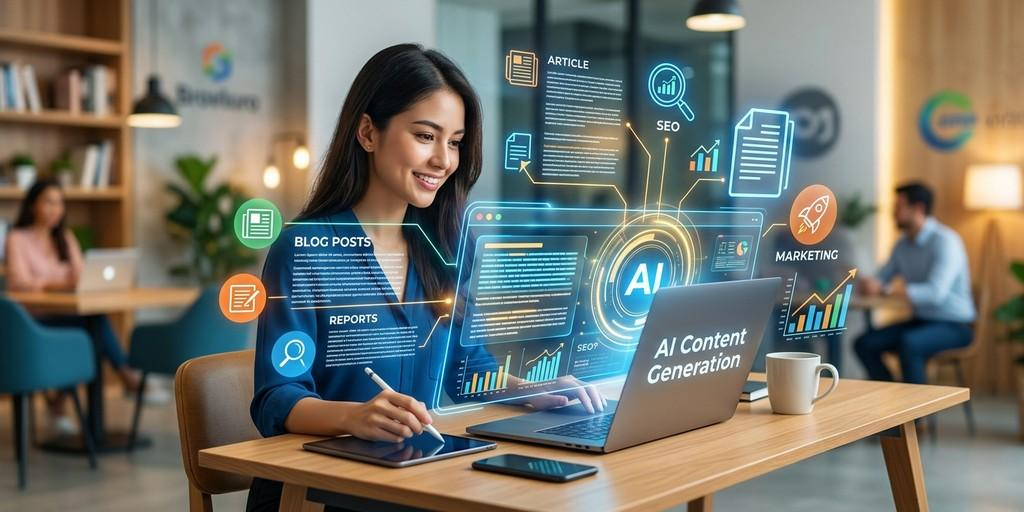
Generative AI has changed the way marketers create content.
Businesses can use AI to generate ideas for:
- Blog posts
- Social media captions
- Email campaigns
- Product descriptions
- Advertising copy
- Video scripts
- Headlines
- Marketing concepts
However, AI-generated content should be reviewed by humans. Brand tone, accuracy, originality, and customer relevance still require human oversight.
The strongest approach is to use AI to accelerate the creative process rather than publishing unedited machine-generated content.
3. AI-Powered Advertising
Advertising platforms are increasingly using AI to improve campaign performance.
AI can help analyze audiences, identify potential customers, test creative variations, optimize bids, and allocate advertising budgets.
This can make paid advertising more efficient because campaigns can respond to performance data continuously.
For marketers, the role is increasingly shifting from manually controlling every campaign setting toward defining objectives, providing quality inputs, monitoring performance, and making strategic decisions.
4. AI Search Optimization
Search is changing because consumers increasingly use AI-powered tools to find information.
Traditional SEO remains important, but businesses are also thinking about how their content can be understood and surfaced by AI-powered search and answer engines.
This means websites should provide clear, accurate, useful, and well-structured information.
Businesses should focus on:
- Clear answers to customer questions
- Helpful FAQs
- Structured website content
- Original information
- Relevant entities and topics
- Authoritative sources
- Updated business information
AI search is therefore becoming an important part of modern AI Marketing strategies.
5. Predictive Analytics
Predictive analytics uses historical and current data to identify potential future outcomes.
In marketing, AI can help estimate which customers may be more likely to purchase, which leads may require additional attention, or which products may experience increased demand.
For example, an online retailer can use customer behavior data to identify people who may be ready to make another purchase.
Predictive analytics can help marketers move from simply analyzing what happened to planning what may happen next.
6. AI Chatbots and Customer Support
AI-powered chatbots are becoming increasingly useful for businesses.
A chatbot can answer common questions, provide product information, help customers navigate a website, collect basic lead information, and provide support outside normal business hours.
AI-powered customer conversations can also become more personalized when businesses have reliable customer data.
Salesforce reported that 92% of surveyed marketers in India said customers increasingly expect brands to support two-way conversations.
7. AI Marketing Automation
Automation is another major area of AI Marketing.
Businesses can automate repetitive marketing activities such as:
- Email sequences
- Lead nurturing
- Customer segmentation
- Campaign reporting
- Content recommendations
- Follow-up messages
- Customer notifications
AI can make automation more flexible by adapting actions according to customer behavior.
For example, instead of sending the same email sequence to everyone, an AI system can help determine which message is more appropriate based on customer activity.

8. AI Agents in Marketing
One of the emerging developments in 2026 is the use of AI agents.
Unlike simple AI tools that respond to individual requests, AI agents can potentially perform multi-step tasks based on defined objectives.
In marketing, agentic systems may assist with campaign planning, research, content workflows, analysis, optimization, and customer interactions.
BCG’s 2026 CMO research found that while many organizations are experimenting with generative AI, only a smaller share had moved to agent-led workflows or more autonomous campaign systems.
This suggests that businesses are still developing the infrastructure, processes, and governance required for more autonomous AI Marketing.
Benefits of AI Marketing
Faster Marketing Processes
AI can complete many repetitive tasks quickly. This allows marketing teams to spend more time on strategy and creativity.
Better Customer Personalization
AI can help businesses understand different customer groups and deliver more relevant experiences.
Improved Data Analysis
Businesses collect large amounts of information. AI can process this information and identify patterns more efficiently than manual analysis.
Better Campaign Optimization
AI can monitor campaign performance and identify opportunities for improvement.
Increased Productivity
Marketing teams can use AI to assist with research, content development, reporting, and repetitive workflows.
24/7 Customer Assistance
AI chatbots can provide basic customer support around the clock.
AI Marketing for Small Businesses
Small businesses can also benefit from AI Marketing without building complicated AI systems.
A small company can begin with simple applications such as:
- AI-assisted content planning
- Social media idea generation
- Email personalization
- Customer FAQ chatbots
- Advertising analysis
- Lead qualification
- Website content optimization
- Customer segmentation
The key is to select tools based on actual business needs rather than adopting AI simply because it is popular.
A small business selling clothing, for example, could use AI to analyze customer preferences, create product content, personalize email campaigns, and identify high-performing advertisements.
AI Marketing and Social Media
Social media marketing is another area where AI is becoming increasingly useful.
AI can assist marketers with content ideas, audience analysis, social listening, scheduling, creative variations, and performance reporting.
Short-form videos, creator content, personalized recommendations, and conversational experiences are increasingly important in digital marketing.
However, social media success still depends heavily on authenticity. AI-generated content should not make a brand appear robotic or disconnected from its audience.
Human creativity remains essential for storytelling, community building, and emotional connection.
AI Marketing and Email Marketing
Email marketing can become more personalized with AI.
AI can help businesses determine:
- Which customers should receive a message
- What type of content may be relevant
- When messages should be sent
- Which subject lines should be tested
- Which customers may need follow-up
For example, an online store can create different email experiences for new customers, returning customers, inactive customers, and high-value customers.
This can make email communication more relevant and reduce unnecessary messaging.
AI Marketing and SEO
SEO is also changing because AI is influencing how people search for information.
Businesses should continue creating high-quality website content while also making information easy for AI systems to understand.
A strong strategy includes:
- Helpful articles
- Clear headings
- Descriptive titles
- Relevant keywords
- FAQs
- Original research
- Internal linking
- Structured information
- Updated content
The focus keyword AI Marketing should be included naturally in important locations such as the title, introduction, headings where relevant, URL, meta description, and image alt text.
Keyword stuffing should be avoided because excessive repetition can make content unnatural and reduce readability.
Challenges of AI Marketing
Although AI Marketing provides many opportunities, it also creates challenges.
Data Privacy
Businesses need to handle customer information responsibly and follow applicable privacy requirements.
Incorrect Information
AI systems can sometimes generate inaccurate or misleading information. Human review is important, particularly for factual claims.
Brand Consistency
AI-generated content may not automatically match a company’s tone or values. Brand guidelines and human editing are necessary.
Lack of Quality Data
AI systems depend on data. Poor, outdated, or fragmented information can reduce the quality of AI-driven decisions.
Over-Automation
Automating everything can remove important human interaction. Businesses should determine which activities benefit from automation and which require human involvement.
How to Build an AI Marketing Strategy
Businesses can introduce AI gradually.
Step 1: Define Your Goal
Decide what you want to improve. It could be lead generation, customer service, content creation, advertising, or sales.
Step 2: Identify Repetitive Tasks
Find activities that consume significant time and can reasonably be automated.
Step 3: Improve Your Data
Make sure customer and marketing data is accurate, organized, and accessible.
Step 4: Select Suitable AI Tools
Choose tools based on your objectives rather than using every new AI product.
Step 5: Keep Humans in Control
Marketing decisions involving brand reputation, sensitive information, and important customer relationships should receive appropriate human oversight.
Step 6: Measure Results
Track metrics such as conversion rate, customer acquisition cost, engagement, revenue, return on advertising spend, and productivity.
Future of AI Marketing
The future of AI Marketing will likely involve deeper integration between AI systems, customer data, advertising platforms, search, commerce, and content.
Marketing may increasingly move from isolated campaigns toward continuous customer journeys.
AI agents could assist with research, planning, personalization, customer communication, and optimization. At the same time, human marketers will continue to provide creativity, strategic direction, brand understanding, and ethical judgment.
Gartner’s 2026 marketing predictions also highlight the growing role of agentic AI, AI-driven customer interactions, authenticity, and consumer trust.
The businesses that benefit from AI will not necessarily be those using the largest number of tools. Instead, successful implementation will depend on having clear objectives, quality data, effective workflows, strong brand guidelines, and appropriate human oversight.
AI Marketing for Different Industries
One of the biggest advantages of AI Marketing is that it can be adapted to different industries. Every business has different customers, goals, and marketing challenges, so AI applications can vary significantly.
AI Marketing for E-Commerce
E-commerce businesses can use AI to understand shopping behavior and improve product recommendations. AI can analyze browsing history, previous purchases, search behavior, and customer preferences.
Businesses can also use AI to create product descriptions, generate advertising variations, personalize email campaigns, and identify customers who may be ready to purchase.
For example, if a customer frequently views sports shoes, an AI-powered system may recommend related footwear, accessories, or special offers. This creates a more relevant shopping experience while helping businesses improve customer engagement.
AI Marketing for Real Estate
Real estate companies can use AI to identify potential buyers, analyze customer inquiries, create property descriptions, and personalize communication.
AI chatbots can answer common questions about properties, locations, prices, and availability. Marketing teams can also use AI to organize leads and identify prospects that may require immediate follow-up.
This can reduce repetitive work and allow sales teams to spend more time communicating with serious prospects.
AI Marketing for Travel and Hospitality
Hotels, resorts, and travel companies can use AI Marketing to personalize recommendations and improve customer communication.
AI can analyze customer preferences and suggest destinations, hotel rooms, packages, activities, or travel offers. Chatbots can provide information about bookings, check-in times, facilities, and frequently asked questions.
AI can also help travel companies create different promotional campaigns for families, couples, business travelers, and other customer groups.
AI Marketing for Healthcare
Healthcare organizations can use AI to improve communication, appointment reminders, educational content, and customer support. However, healthcare marketing requires careful handling of personal information and should follow applicable privacy and regulatory requirements.
AI can help organize marketing data and create general educational content, while sensitive decisions and communications should receive appropriate professional oversight.
How AI Marketing Can Improve Customer Journeys
Modern customers rarely make a purchase after seeing only one advertisement. They may first discover a brand through social media, visit its website, read reviews, compare products, receive an email, and eventually make a purchase.
AI Marketing can help businesses understand this customer journey.
AI can analyze interactions across different channels and identify where customers may need additional information. For example, someone who visits a product page several times but does not purchase may receive a relevant reminder or educational message.
This approach can make marketing more connected instead of treating every advertisement or message as a separate campaign.
Businesses can use AI throughout several stages:
- Awareness – identifying audiences and creating relevant content.
- Interest – providing personalized information and recommendations.
- Consideration – answering questions and comparing products.
- Conversion – supporting offers, advertisements, and follow-ups.
- Retention – sending relevant messages to existing customers.
- Loyalty – identifying opportunities for repeat purchases and stronger relationships.
The goal is to create a consistent experience while allowing customers to interact with the brand through the channels they prefer.
AI Marketing and Customer Data
Data is one of the foundations of effective AI Marketing. AI systems require useful information to generate meaningful insights.
Customer data may include website interactions, purchase history, email engagement, product preferences, advertising responses, and customer-service interactions.
However, having large amounts of data does not automatically guarantee better marketing. Data needs to be accurate, relevant, organized, and responsibly managed.
Salesforce’s 2026 India research found that data quality and fragmented customer information remain significant barriers to AI-driven personalization. The report also found that 81% of surveyed Indian marketers had adopted AI.
This means businesses should focus not only on acquiring AI tools but also on improving their data foundations.
A company with clean and connected data may be better positioned to create useful personalized experiences than a company with many disconnected systems.
Measuring the ROI of AI Marketing
Businesses should measure whether AI Marketing is actually producing useful results.
Simply using an AI tool does not mean a marketing strategy is successful. Companies should compare performance before and after implementation and identify measurable improvements.
Important metrics can include:
- Conversion rate
- Cost per lead
- Customer acquisition cost
- Return on advertising spend
- Website engagement
- Email open and click rates
- Customer retention
- Revenue generated
- Marketing productivity
- Time saved
For example, if AI reduces the time required to produce a campaign by 40%, that productivity improvement can be measured. If AI personalization increases conversions, the business can measure the change in revenue or leads.
The most useful approach is to connect AI activities with actual business objectives.
Human Creativity Still Matters
Despite rapid technological development, human creativity remains important in AI Marketing.
AI can generate headlines, content ideas, customer segments, and campaign variations. However, humans understand brand identity, cultural context, emotions, and long-term relationships in ways that automated systems may not fully capture.
HubSpot’s 2026 State of Marketing report emphasizes that AI is becoming a baseline technology while human-led marketing remains important for authenticity, trust, and brand differentiation.
This creates a useful balance: AI can help businesses work faster, while people remain responsible for important creative and strategic decisions.
For example, AI may generate ten advertising concepts, but a marketing professional can select, improve, and adapt the concept that best matches the company’s audience and brand.
Building Trust With AI Marketing
Trust is becoming increasingly important as AI-generated content becomes more common.
Customers may interact with AI chatbots, see AI-generated advertisements, or read content created with AI assistance. Businesses therefore need to maintain transparency, accuracy, and consistency.
Brands should avoid publishing inaccurate AI-generated information simply because it was produced quickly.
A strong AI Marketing strategy should include:
- Human review
- Accurate information
- Clear brand guidelines
- Responsible data handling
- Appropriate privacy practices
- Regular performance monitoring
- Consistent customer experiences
The objective should be to use technology to improve the customer experience rather than simply increasing the amount of content a company publishes.
Practical AI Marketing Strategy for 2026
Businesses that are beginning their AI journey can follow a simple process.
First, identify one specific marketing problem. It could be slow content production, poor lead follow-up, limited personalization, or inefficient reporting.
Next, select an AI solution that directly addresses that problem. Start with a manageable project rather than attempting to automate the entire marketing department.
After implementation, measure the results. If the system saves time, improves engagement, reduces costs, or increases conversions, the business can gradually expand its use.
Businesses should also train employees. An AI tool is only useful when marketing teams understand how to use it effectively and how to evaluate its output.
In 2026, the focus is increasingly moving from simply experimenting with AI toward integrating it into useful business workflows. Salesforce’s recent India research similarly emphasizes moving from AI experimentation toward responsible, connected, measurable adoption.
Final Thoughts on AI Marketing in 2026
The growth of AI Marketing is changing the marketing industry from content creation and advertising to customer service, search, personalization, analytics, and automation.
The technology offers businesses an opportunity to process information faster, create personalized experiences, automate repetitive work, and understand customers more effectively.
At the same time, AI should not be treated as a complete replacement for human marketers. Successful marketing still depends on creativity, trust, strategic thinking, brand identity, and a strong understanding of customers.
The most effective approach in 2026 is therefore a combination of artificial intelligence and human expertise. Businesses can use AI to handle repetitive and data-intensive tasks while marketing professionals focus on decisions that require creativity, context, judgment, and empathy.
As AI continues to develop, businesses that build strong data foundations, use AI responsibly, measure real results, and maintain human oversight can create more useful and personalized customer experiences.
Conclusion
AI Marketing is transforming the way businesses attract, understand, and communicate with customers in 2026. From personalized content and predictive analytics to AI advertising, chatbots, search optimization, automation, and AI agents, artificial intelligence is becoming part of many stages of the marketing process.
For businesses, the goal should not simply be to use AI everywhere. The goal should be to use AI where it creates measurable value.
A successful strategy combines the speed and analytical capabilities of artificial intelligence with human creativity, strategic thinking, authenticity, and customer understanding.
As technology continues to develop, AI Marketing will remain an important part of the digital marketing landscape. Businesses that learn how to use these technologies responsibly and effectively can create more personalized experiences, improve productivity, and build stronger connections with their customers.