
Best Study Techniques for Academic Success: Powerful Strategies for 2026. Academic success is not simply about spending more hours with your books. In 2026, students have access to more educational resources than ever before, including digital classrooms, online courses, educational applications, AI-powered learning tools, video lessons, digital libraries, and interactive study platforms. However, having access to information does not automatically lead to better academic results. Students also need effective strategies for understanding, remembering, and applying what they learn.
This is why finding the Best Study Techniques for Academic Success can make a significant difference. The right study methods can help students improve concentration, retain information for longer, understand difficult concepts, prepare efficiently for examinations, and manage academic responsibilities without unnecessary stress.
Effective studying involves active participation. Instead of simply looking at information, students should question it, recall it, explain it, practice it, and revisit it over time.
In this comprehensive guide, we explore the Best Study Techniques for Academic Success that students can use in 2026 to create more productive, organized, and sustainable learning habits.
Why Study Techniques Matter for Academic Success
Every student has a limited amount of time and mental energy. The challenge is to use both effectively.
Studying for several hours does not necessarily mean that meaningful learning has occurred. A student may spend three hours reading a textbook while frequently checking a phone, browsing social media, or thinking about unrelated tasks. Another student may spend one focused hour actively testing their knowledge and solving practice problems.
The second approach can be considerably more productive.
The Best Study Techniques for Academic Success focus on improving the quality of learning rather than simply increasing the number of study hours.
Effective study strategies can help students:
- Improve concentration.
- Understand complex subjects.
- Remember information for longer.
- Identify weaknesses.
- Reduce procrastination.
- Prepare for examinations systematically.
- Improve time management.
- Build confidence.
- Develop independent learning skills.
- Reduce dependence on last-minute cramming.
The goal should not be to study constantly. The goal should be to study intelligently and consistently.
1. Practice Active Recall
Active recall is one of the Best Study Techniques for Academic Success because it requires your brain to retrieve information instead of merely recognizing it.
After studying a topic, close your textbook and ask yourself questions about what you just learned.
For example, after studying a chapter about the human circulatory system, ask:
- What is the function of the heart?
- What are the major blood vessels?
- How does oxygen move through the body?
- What is the difference between arteries and veins?
Try answering without looking at your notes.
If you cannot answer a question, check the material and try again later.
You can practice active recall using flashcards, quizzes, practice questions, blank-page exercises, or verbal explanations.
The important thing is to make yourself retrieve the information.
2. Use Spaced Repetition
Studying information once does not guarantee that you will remember it weeks later.
Spaced repetition involves reviewing information at carefully planned intervals.
For example, you could review new material:
- On the same day.
- The next day.
- Three days later.
- One week later.
- Two weeks later.
- Before the examination.
This method prevents students from leaving all revision until examination week.
Spaced repetition is particularly useful for vocabulary, formulas, definitions, scientific terminology, historical information, and other factual material.
Combining spaced repetition with active recall can make the Best Study Techniques for Academic Success even more effective.
3. Use the Pomodoro Technique
Concentration can decrease when students attempt to work continuously for several hours.
The Pomodoro Technique divides studying into focused work periods followed by short breaks.
A traditional approach uses approximately 25 minutes of focused study followed by a five-minute break. After several sessions, students can take a longer break.
However, you can customize the timing.
For example:
- 25 minutes study + 5 minutes break.
- 40 minutes study + 10 minutes break.
- 50 minutes study + 10 minutes break.
During the focus period, avoid unnecessary distractions.
Put your phone away, close unrelated websites, and focus on one specific task.
Time-based study sessions are among the Best Study Techniques for Academic Success for students who struggle with procrastination or maintaining concentration.
4. Apply the Feynman Technique
The Feynman Technique encourages students to explain difficult concepts in simple language.
Choose a topic and pretend that you are teaching it to someone who has never studied it before.
Explain the concept without relying heavily on complicated terminology.
If you become confused or cannot explain a particular part, identify the gap in your understanding. Return to your study material, learn that section again, and attempt the explanation once more.
For example, instead of memorizing a definition of photosynthesis, explain:
- What photosynthesis is.
- Where it occurs.
- Why plants need sunlight.
- What role carbon dioxide plays.
- What products are created.
The ability to explain a concept clearly is often a useful indication that you understand it.
This makes the Feynman Technique one of the Best Study Techniques for Academic Success, particularly for subjects that require conceptual understanding.
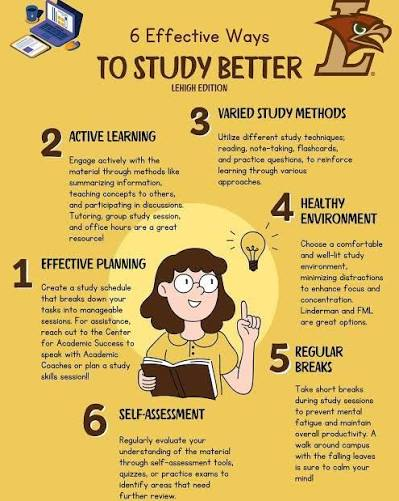
5. Create a Realistic Study Schedule
A good study schedule can prevent students from feeling overwhelmed.
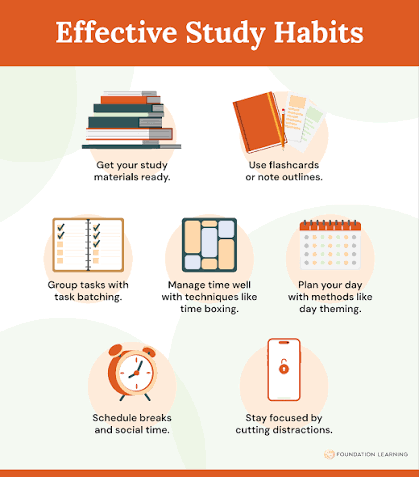
Start by listing your academic responsibilities, including classes, assignments, examinations, projects, reading, and revision.
Then divide these responsibilities into smaller tasks.
Instead of writing:
“Study chemistry.”
Write:
“Review chemical bonding and complete 15 practice questions.”
Specific tasks make progress easier to measure.
Your schedule should also be realistic. If you create an impossible timetable, missing one session may cause the entire plan to collapse.
Leave some flexibility for unexpected assignments and personal responsibilities.
Planning your time effectively is one of the Best Study Techniques for Academic Success because it turns vague academic goals into specific daily actions.
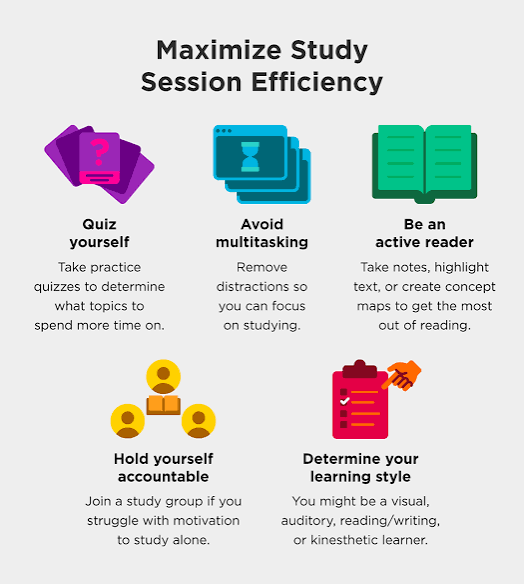
6. Take Practice Tests
Practice testing allows you to discover what you actually know.
Reading notes can create a feeling of familiarity, but answering questions without looking at your material provides a more meaningful test of your knowledge.
Use:
- Previous examination papers.
- Textbook questions.
- Teacher-provided worksheets.
- Online quizzes.
- Self-created questions.
- Timed mock examinations.
After completing a practice test, do not simply check your score.
Analyze your mistakes.
Ask yourself:
- Did I misunderstand the concept?
- Did I forget an important fact?
- Did I use the wrong formula?
- Did I misread the question?
- Did I run out of time?
- Was the mistake caused by careless calculation?
Practice testing is among the Best Study Techniques for Academic Success because it combines retrieval, application, and feedback.
7. Maintain an Error Log
Your mistakes can become valuable study material.
Create an error log where you record important questions that you answered incorrectly.
For each mistake, write:
- The original question.
- Your answer.
- The correct answer.
- The reason your answer was incorrect.
- The concept involved.
- What you will do differently next time.
Review your error log every week.
This is particularly useful for mathematics, physics, chemistry, accounting, programming, and other subjects where students solve problems repeatedly.
Instead of avoiding mistakes, use them to identify patterns in your learning.
An error log can therefore become an important addition to the Best Study Techniques for Academic Success.
8. Make Mind Maps
Mind maps can help students organize large amounts of information visually.
Start with the main topic in the center of a page. Create branches for major ideas and smaller branches for supporting details.
For example, a mind map about the environment could include:
Environment
→ Pollution
→ Climate
→ Ecosystems
→ Biodiversity
→ Natural resources
→ Conservation
Mind maps are useful for revision because they show relationships between concepts.
They can also make complicated chapters easier to review before an examination.
For visually oriented learners, mind mapping can be one of the Best Study Techniques for Academic Success.
9. Improve Your Note-Taking
Effective notes do not need to contain every word from a lecture.
Instead, focus on important information such as:
- Main ideas.
- Definitions.
- Examples.
- Formulas.
- Key arguments.
- Questions.
- Important explanations.
The Cornell Note-Taking System is one possible approach.
Divide your page into a large notes section, a smaller question or cue section, and a summary section.
After class, turn important information into questions. During revision, cover the answers and test yourself.
This turns ordinary class notes into an active revision resource.
Better note-taking is one of the practical Best Study Techniques for Academic Success because it improves both learning and future revision.
10. Study Difficult Topics First
Students often prefer studying subjects they already understand.
While this may feel comfortable, it can result in spending too much time reviewing familiar information.
Identify the subjects and topics that require the most attention.
If you are most focused in the morning, consider using that period for difficult subjects.
Reserve easier activities for times when your energy is lower.
This strategy ensures that your best concentration is used for your most demanding academic tasks.
Prioritizing challenging material is therefore one of the Best Study Techniques for Academic Success for students managing multiple subjects.
11. Use Interleaving
Interleaving involves mixing different types of problems or topics during a study session.
For example, instead of completing 30 identical mathematics problems, practice several different types of questions.
You may solve:
- Algebra.
- Geometry.
- Probability.
- Functions.
- Word problems.
This forces you to determine which method is appropriate for each problem.
Interleaving is particularly useful when students need to recognize different problem types during examinations.
As part of the Best Study Techniques for Academic Success, interleaving can help develop flexible problem-solving skills.
12. Teach What You Have Learned
Teaching someone else can expose gaps in your understanding.
Choose a topic and explain it to a friend, classmate, family member, or even an imaginary student.
Avoid simply reading your notes aloud.
Instead, explain the idea in your own words and provide examples.
If someone asks a question that you cannot answer, investigate it and update your understanding.
Teaching requires you to organize information, retrieve it, connect ideas, and communicate clearly.
That is why teaching is often included among the Best Study Techniques for Academic Success.
13. Set Specific Study Goals
A vague goal such as “I will study more today” does not tell you what needs to be accomplished.
Instead, establish specific goals.
For example:
“I will complete 20 mathematics questions and review every incorrect answer.”
Or:
“I will learn 30 Spanish vocabulary words and test myself twice.”
Specific goals make study sessions measurable.
You can also divide larger academic goals into weekly targets.
Goal-setting helps students stay focused and makes the Best Study Techniques for Academic Success easier to implement consistently.
14. Reduce Digital Distractions
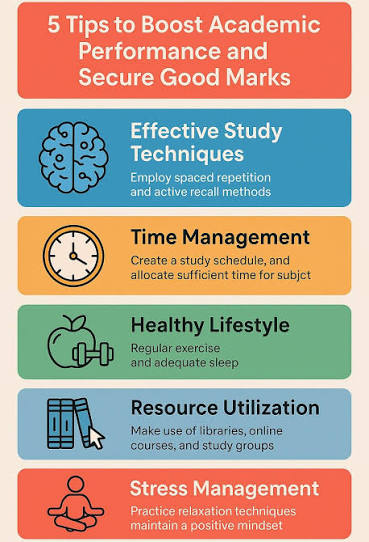
Technology can be an excellent educational resource, but it can also become a major distraction.
Notifications, social media, entertainment platforms, messaging applications, and unrelated websites can interrupt concentration.
Before beginning a study session:
- Turn off unnecessary notifications.
- Put your phone away.
- Close unrelated browser tabs.
- Use a website blocker if necessary.
- Keep only essential applications open.
You do not need to eliminate technology entirely.
Instead, use it intentionally for learning.
Digital distraction management is one of the simplest Best Study Techniques for Academic Success that students can implement immediately.
15. Use Flashcards Effectively
Flashcards are particularly useful for information that needs repeated recall.
A good flashcard should contain a focused question or prompt on one side and the answer on the other.
For example:
Front: What is the capital of France?
Back: Paris.
For more advanced subjects, flashcards can contain conceptual questions rather than simple facts.
Instead of writing an entire paragraph on a card, ask a question that requires explanation.
Combine flashcards with spaced repetition for better long-term review.
Used correctly, flashcards can become one of the Best Study Techniques for Academic Success for memory-based subjects.
16. Use the SQ3R Reading Method
SQ3R stands for:
- Survey.
- Question.
- Read.
- Recite.
- Review.
First, survey the chapter by looking at headings, subheadings, diagrams, summaries, and key terms.
Next, create questions.
Then read actively to find the answers.
After reading a section, close the book and recite the main ideas.
Finally, review the material later.
This method makes textbook reading more active and purposeful.
For students who have large amounts of reading, SQ3R can be included among the Best Study Techniques for Academic Success.
17. Use Short Study Sessions Consistently
Consistency is more valuable than occasional extreme effort.
Instead of studying a subject for six hours once a week, consider shorter sessions spread across several days.
For example:
- Monday: 30 minutes.
- Tuesday: 30 minutes.
- Thursday: 45 minutes.
- Saturday: 60 minutes.
Frequent exposure allows you to revisit concepts and identify problems before they become serious.
Short, consistent sessions are therefore among the Best Study Techniques for Academic Success for building sustainable academic habits.
18. Take Effective Breaks
Breaks are important for maintaining concentration.
During a short break, move away from your desk. Stretch, walk around, drink water, or simply rest your eyes.
Try not to turn a five-minute break into a long social media session.
The purpose of a break is to restore attention so that you can return to your work.
Strategic breaks can make the Best Study Techniques for Academic Success easier to maintain over extended study periods.
19. Get Enough Sleep
Students sometimes sacrifice sleep to gain additional study hours.
However, studying late into the night is not necessarily productive if fatigue makes it difficult to concentrate or remember information the following day.
Create a routine that gives you adequate time for sleep and recovery.
A balanced academic lifestyle should include:
- Focused study.
- Regular meals.
- Physical activity.
- Relaxation.
- Social time.
- Adequate sleep.
Healthy routines support the effectiveness of the Best Study Techniques for Academic Success because learning requires both effort and recovery.
20. Use Educational Technology Responsibly
In 2026, students can access a wide variety of digital learning resources.
These include online courses, digital libraries, educational videos, flashcard applications, practice platforms, productivity tools, and AI-based learning assistants.
Use these resources as learning aids rather than replacements for thinking.
For example, if an AI tool explains a difficult concept, try explaining the concept yourself afterward.
If a digital platform generates practice questions, attempt them without immediately checking the answers.
Responsible technology use can enhance the Best Study Techniques for Academic Success without reducing independent thinking.
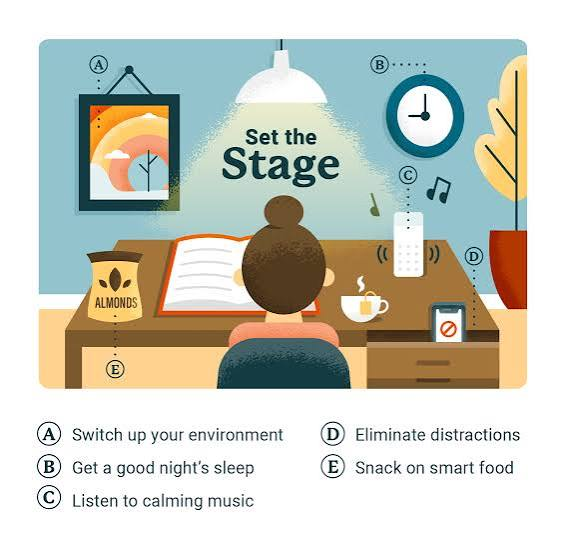
21. Create a Productive Study Environment
Your environment can influence your concentration.
Choose a location that is comfortable, organized, well-lit, and relatively quiet.
Before starting, prepare everything you need.
Keep your textbook, notebook, stationery, water, calculator, and other necessary materials nearby.
A cluttered workspace can create unnecessary distractions.
A consistent study environment can also help establish a routine.
Creating a productive environment supports the Best Study Techniques for Academic Success by making focused study easier to start and maintain.
22. Study With Others Strategically
Study groups can be highly useful when they are structured.
A productive group might involve:
- Quizzing one another.
- Explaining difficult concepts.
- Comparing solutions.
- Discussing practice questions.
- Teaching different topics.
- Reviewing mistakes.
Before starting, agree on what the group needs to accomplish.
Without a clear purpose, study groups can easily become social gatherings.
Used properly, collaborative learning can complement the Best Study Techniques for Academic Success.
23. Review Material Before It Is Forgotten
Do not wait until examination week to review material.
After learning something new, schedule a brief review.
For example:
Day 1: Learn the topic.
Day 2: Recall the main concepts.
Day 4: Complete practice questions.
Day 7: Review again.
Day 14: Test yourself.
This approach distributes learning over time and reduces the pressure of last-minute revision.
Regular review is therefore one of the Best Study Techniques for Academic Success for long-term retention.
24. Focus on Understanding
Memorization has an important role in many subjects, but understanding makes information easier to use.
Ask questions such as:
- Why does this happen?
- How does this process work?
- What causes this result?
- How are these concepts connected?
- Can I provide an example?
- What would happen if the situation changed?
These questions encourage deeper learning.
Conceptual understanding is one of the Best Study Techniques for Academic Success because many examinations require students to apply knowledge rather than simply repeat definitions.
25. Review Your Mistakes Weekly
At the end of every week, spend some time reviewing your academic progress.
Ask:
- What did I learn?
- Which topics remain difficult?
- Which mistakes occurred repeatedly?
- Did I follow my schedule?
- Which study methods worked?
- What should I change next week?
This process helps you continuously improve your approach.
Weekly reflection can make the Best Study Techniques for Academic Success more personalized because you can adjust your strategy according to your actual performance.
How to Combine the Best Study Techniques for Academic Success
Using twenty different methods simultaneously is unnecessary.
Instead, create a simple system that combines complementary strategies.
A productive study session could look like this:
Step 1: Set a goal
Decide exactly what you want to accomplish.
Step 2: Learn
Read your textbook, attend a lecture, watch an educational lesson, or review your notes.
Step 3: Recall
Close your materials and explain what you remember.
Step 4: Practice
Complete relevant questions without looking at the solutions.
Step 5: Analyze
Review mistakes and identify weak areas.
Step 6: Review
Schedule another session using spaced repetition.
This workflow brings together several of the Best Study Techniques for Academic Success without making studying unnecessarily complicated.
Sample Weekly Study Routine
A practical weekly routine could look like this:
Monday
Review new material and create active-recall questions.
Tuesday
Complete practice problems and update your error log.
Wednesday
Use flashcards and spaced repetition.
Thursday
Explain difficult concepts using the Feynman Technique.
Friday
Take a timed practice test.
Saturday
Review mistakes and revisit difficult topics.
Sunday
Evaluate your progress and plan the following week.
You can modify this schedule according to your classes, assignments, examinations, and personal commitments.
The objective is to create consistency rather than a perfect timetable.
Common Study Habits That Can Reduce Productivity
Knowing what not to do is also important.
Passive rereading
Reading the same information repeatedly can create familiarity without strong retrieval practice.
Excessive highlighting
Highlighting every sentence makes it difficult to identify genuinely important information.
Last-minute cramming
Cramming may provide short-term exposure but can make learning stressful improve their learning by actively retrieving information, practicing regularly, reviewing material over time, analyzing mistakes, reducing distractions, setting specific goals, and maintaining a balanced routine goal. Remove distractions. Study actively. Test yourself. Learn from mistakes. Review regularly. Take appropriate and difficult to sustain.
Multitasking
Switching constantly between studying and entertainment can disrupt concentration.
Ignoring mistakes
Incorrect answers provide valuable feedback. Ignoring them means missing an opportunity to improve.
Studying without a goal
Opening a textbook without a clear objective can result in an unfocused session.
Replacing these habits with the Best Study Techniques for Academic Success can make study time more productive.
How to Stay Motivated While Studying
Motivation naturally changes from day to day.
Instead of waiting until you feel motivated, develop routines that make starting easier.
Use small goals.
For example, commit to completing one page, five questions, or ten minutes of focused study.
Once you begin, continuing may feel easier.
You can also track completed study sessions, practice questions, chapters, or revision targets.
However, avoid measuring your success only by hours studied.
Quality and consistency matter.
Building routines around the Best Study Techniques for Academic Success can help reduce dependence on temporary motivation.
Personalize Your Study Strategy
There is no single method that works perfectly for every student.
Different subjects require different approaches.
For example:
Mathematics: Practice problems, error logs, and interleaving.
Languages: Flashcards, reading, speaking, and spaced repetition.
Science: Concept explanations, diagrams, practice questions, and active recall.
History: Timelines, active recall, essay practice, and spaced repetition.
Literature: Reading, annotation, discussion, and written analysis.
Experiment with different approaches and monitor your results.
The most effective Best Study Techniques for Academic Success are the ones that fit your subjects, schedule, learning needs, and academic goals.
30-Day Study Improvement Challenge
If you want to improve your study habits, consider following a 30-day challenge.
Week 1: Organize
Create a study schedule, organize your materials, identify difficult subjects, and remove major distractions.
Week 2: Activate
Introduce active recall, practice testing, and the Feynman Technique.
Week 3: Retain
Add spaced repetition, flashcards, and scheduled reviews.
Week 4: Improve
Review your results, identify ineffective habits, and adjust your routine.
After 30 days, you should have a clearer understanding of which Best Study Techniques for Academic Success work well for you.
Final Thoughts
Academic success does not depend solely on intelligence or the number of hours you spend studying. How you study matters.
Students can improve their learning by actively retrieving information, practicing regularly, reviewing material over time, analyzing mistakes, reducing distractions, setting specific goals, and maintaining a balanced routine.
The Best Study Techniques for Academic Success are not complicated shortcuts. They are practical habits that make learning more active, structured, and intentional.
You do not need to adopt every technique immediately. Start with two or three methods and gradually build your system.
For example, begin with active recall and spaced repetition. Then introduce practice tests, error logs, focused study sessions, and weekly reviews.
Consistency is more important than perfection.
As education continues to evolve in 2026, students have unprecedented access to learning resources. The real advantage comes from knowing how to use those resources effectively.
The Best Study Techniques for Academic Success can help students make better use of their available time, understand challenging concepts, prepare more systematically, and develop habits that remain useful throughout their education.
Start with a clear goal. Remove distractions. Study actively. Test yourself. Learn from mistakes. Review regularly. Take appropriate breaks. Protect your sleep. Then repeat the process.
Academic improvement is rarely the result of one extraordinary study session. It is usually the result of small, effective actions repeated consistently over time.
With the right strategy and commitment, students can turn ordinary study sessions into purposeful learning experiences and build a stronger foundation for academic success in 2026 and beyond.