Best Career Skills for Students in 2026: Complete Guide. The world of education and employment is changing rapidly. New technologies, artificial intelligence, remote work, digital businesses, and changing workplace expectations are creating new opportunities for young people. Students who start developing practical abilities early can be better prepared to handle these changes and build meaningful careers. This is why learning the Best Career Skills for Students in 2026 has become an important part of modern education.
Academic qualifications remain valuable, but employers increasingly look for students who can communicate clearly, solve problems, work with technology, manage their time, adapt to change, and collaborate with others. Students can improve these abilities through classroom activities, online courses, internships, projects, volunteering, competitions, and personal practice.
The Best Career Skills for Students in 2026 are not limited to one profession. Whether a student wants to become a business owner, software developer, designer, teacher, healthcare professional, marketer, engineer, researcher, or creative professional, a strong combination of technical and soft skills can be useful.
In this article, we will explore important skills students can develop in 2026, why they matter, and practical ways to build them.
1. Communication Skills
Communication is one of the most useful abilities students can develop for their academic and professional lives. Good communication involves speaking clearly, writing effectively, listening carefully, and presenting ideas confidently.
Students regularly communicate with teachers, classmates, employers, customers, and colleagues. Strong communication can help them explain ideas, participate in discussions, handle interviews, and work effectively in teams.
For students exploring the Best Career Skills for Students in 2026, communication should be an important priority.
Students can improve communication by reading regularly, participating in discussions, giving presentations, writing articles, practicing public speaking, and learning how to listen actively.
2. Digital Literacy
Technology is now part of almost every profession. Students should understand how to use computers, online platforms, productivity applications, digital communication tools, and basic cybersecurity practices.
Digital literacy does not necessarily mean becoming a programmer. It means being comfortable using technology responsibly and efficiently.
Students should learn how to organize digital files, use productivity software, conduct online research, collaborate through digital platforms, and protect personal information.
Among the Best Career Skills for Students in 2026, digital literacy is particularly useful because technology is connected to education, business, communication, and many professional fields.
3. Artificial Intelligence Awareness
Artificial intelligence is becoming increasingly relevant across education and employment. Students do not necessarily need to become AI specialists, but understanding basic AI concepts and responsible AI use can be valuable.
Students can learn how AI systems are used, how to write effective prompts, how to verify AI-generated information, and why privacy and ethical considerations matter.
AI should be treated as a tool that supports learning and productivity rather than something that replaces independent thinking.
Understanding AI is therefore an important part of the Best Career Skills for Students in 2026.
Students can explore AI through educational resources, practical projects, demonstrations, and responsible experimentation.
4. Critical Thinking
Critical thinking helps students examine information before accepting it as true. The internet provides access to enormous amounts of information, but not every piece of information is accurate or reliable.
Students with strong critical-thinking abilities can compare sources, identify assumptions, evaluate evidence, and make reasoned decisions.
Critical thinking is useful in almost every career. Engineers use it to solve technical problems, marketers use it to evaluate campaigns, researchers use it to analyze evidence, and business professionals use it to make decisions.
For this reason, critical thinking deserves a place among the Best Career Skills for Students in 2026.
Students can develop this skill by asking questions, comparing different viewpoints, solving puzzles, analyzing case studies, and discussing real-world problems.
5. Problem-Solving Skills
Every workplace has challenges. Employers need people who can understand problems, identify possible solutions, evaluate alternatives, and take appropriate action.
Problem-solving does not always require advanced technical knowledge. It requires patience, logical thinking, creativity, and the ability to break large challenges into smaller steps.
Students can practice problem-solving through mathematics, coding, business case studies, science experiments, group projects, puzzles, and practical activities.
Developing problem-solving abilities is one of the Best Career Skills for Students in 2026 because these skills can transfer between different careers.
6. Time Management
Students often have to balance classes, assignments, examinations, extracurricular activities, personal responsibilities, and career preparation.
Good time management helps students organize priorities and complete tasks without unnecessary stress. Useful techniques include creating schedules, setting deadlines, dividing large assignments into smaller tasks, and avoiding unnecessary distractions.
Students can experiment with digital calendars, planners, task-management applications, and simple daily to-do lists.
Time management is one of the Best Career Skills for Students in 2026 because professional life also requires people to manage deadlines and responsibilities effectively.
7. Teamwork and Collaboration
Modern workplaces often depend on teams. Students may eventually work with people from different backgrounds, locations, cultures, and professional specialties.
Teamwork involves sharing responsibilities, respecting different opinions, communicating clearly, and helping a group reach a common objective.
Students can develop collaboration skills by participating in group assignments, sports, clubs, competitions, volunteer activities, and community projects.
Learning how to contribute to a team is an important part of the Best Career Skills for Students in 2026.
8. Adaptability
The professional world can change quickly. Technologies, industries, customer expectations, and job responsibilities can evolve over time.
Adaptability means being willing to learn new things and adjust when circumstances change. Students who develop this ability may find it easier to handle new academic requirements, technologies, work environments, and career opportunities.
Students can improve adaptability by trying unfamiliar activities, learning new tools, accepting constructive feedback, and developing a habit of continuous learning.
Adaptability is therefore one of the Best Career Skills for Students in 2026.
9. Creativity
Creativity is valuable far beyond traditional artistic careers. Businesses need creative approaches to marketing, product development, communication, customer service, and problem-solving.
Creative students can learn to look at problems from different perspectives and develop multiple possible solutions.
Students can strengthen creativity through writing, drawing, photography, video production, design projects, brainstorming exercises, music, entrepreneurship projects, and innovative school assignments.
Creativity is another important element of the Best Career Skills for Students in 2026.
10. Leadership
Leadership does not simply mean managing other people. It also means taking responsibility, communicating a vision, making decisions, supporting teammates, and helping a group move toward a goal.
Students can develop leadership by organizing events, participating in student organizations, leading group projects, volunteering, or starting small community initiatives.
Good leaders also know how to listen and accept feedback.
Leadership belongs among the Best Career Skills for Students in 2026 because many professional opportunities require people who can take responsibility and work effectively with others.
11. Emotional Intelligence
Emotional intelligence involves recognizing and managing emotions while understanding the feelings and perspectives of other people.
This ability can help students handle disagreements, build relationships, respond to feedback, and communicate respectfully.
Emotional intelligence is especially useful in careers involving teamwork, customers, leadership, teaching, healthcare, management, and communication.
Students can improve emotional intelligence by practicing active listening, reflecting on their reactions, showing empathy, and learning to communicate calmly.
For many students, emotional intelligence can become one of the Best Career Skills for Students in 2026.
12. Financial Literacy
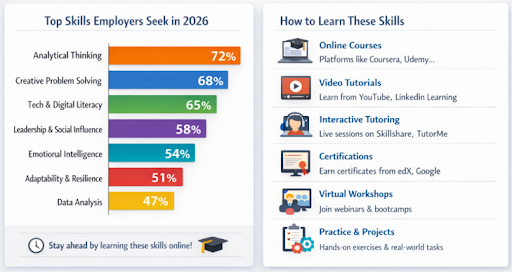
Understanding money is an important life and career skill. Students should learn basic concepts such as budgeting, saving, responsible spending, banking, credit, investing fundamentals, and financial planning.
Financial literacy can help young adults make informed decisions when they begin earning money.
Students can start with a simple monthly budget. They can track income and expenses and learn the difference between needs and wants.
Financial literacy is an increasingly useful part of the Best Career Skills for Students in 2026 because career success involves not only earning income but also managing it responsibly.
13. Networking Skills
Networking means building professional relationships with people who share career, academic, or professional interests.
Students can start networking long before they graduate. They can attend seminars, workshops, career fairs, competitions, professional events, and educational communities.
A professional online profile can also help students showcase their interests, projects, certifications, and achievements.
Networking is included in the Best Career Skills for Students in 2026 because relationships can provide opportunities to learn about industries, internships, projects, and career paths.
14. Presentation Skills
Students may have excellent ideas but still need to communicate them effectively. Presentation skills help students explain information to an audience in a structured and engaging way.
A good presentation generally includes a clear introduction, logical organization, useful visuals, confident delivery, and a strong conclusion.
Students can practice by presenting classroom projects, recording themselves, participating in speaking activities, or joining public-speaking groups.
Presentation ability is another valuable component of the Best Career Skills for Students in 2026.
15. Research Skills
Research skills help students find, evaluate, organize, and present reliable information.
These skills are useful for academic assignments as well as professional projects. Students should learn how to identify trustworthy sources, compare information, take useful notes, and distinguish evidence from unsupported claims.
Good research also requires understanding the limitations of information and checking important facts before using them.
Research skills deserve attention when discussing the Best Career Skills for Students in 2026 because information is central to many modern careers.
16. Data Literacy
Data is used in business, healthcare, education, technology, marketing, finance, science, and many other industries.
Students do not all need to become data scientists. However, understanding basic data concepts can be useful. Students can learn how to read charts, interpret percentages, understand averages, identify trends, and draw reasonable conclusions from data.
Learning spreadsheet tools can provide a practical starting point.
Data literacy is therefore another useful part of the Best Career Skills for Students in 2026.
17. Basic Coding Skills
Coding has become useful across many industries. Even students who do not plan to become software developers can benefit from understanding basic programming concepts.
Coding teaches logical thinking, sequencing, experimentation, and problem-solving.
Beginners can explore languages and platforms designed for learning, including block-based programming environments and beginner-friendly programming languages.
Basic coding knowledge can strengthen the technical foundation within the Best Career Skills for Students in 2026.
18. Digital Marketing Skills
Digital marketing has created opportunities in content creation, search engine optimization, social media, advertising, email marketing, analytics, and brand communication.
Students interested in business or entrepreneurship can begin learning the fundamentals of digital marketing through practical projects.
They can create a small blog, study search behavior, practice writing social media content, learn basic analytics, and explore responsible advertising strategies.
Digital marketing is another career-oriented area within the Best Career Skills for Students in 2026.
19. Writing Skills
Writing remains important even in highly digital workplaces. Students may need to write emails, reports, proposals, presentations, applications, articles, social media posts, or project documentation.
Good professional writing should be clear, concise, organized, and appropriate for its audience.
Students can improve writing by reading high-quality material, practicing regularly, revising their work, and learning basic grammar and structure.
Strong writing is an essential part of the Best Career Skills for Students in 2026.
20. Research-Based Learning and Continuous Learning
Education should not stop after graduation. Industries continue to evolve, and professionals often need to learn new technologies, tools, and methods throughout their careers.
Students can develop a lifelong-learning mindset by taking online courses, reading industry publications, attending workshops, watching educational lectures, and working on personal projects.
Continuous learning connects many of the Best Career Skills for Students in 2026 because career development is an ongoing process.
How Students Can Develop Career Skills
Knowing which skills matter is only the first step. Students need regular practice to turn knowledge into ability.
One useful approach is to choose two or three skills at a time instead of trying to learn everything simultaneously.
For example, a student might focus on communication, digital literacy, and time management for one semester. During the next semester, the student could focus on problem-solving, teamwork, and presentation skills.
The Best Career Skills for Students in 2026 can be developed through practical experiences rather than only theoretical study.
Students can:
- Join school or college clubs.
- Participate in competitions.
- Complete online courses.
- Work on personal projects.
- Volunteer for community activities.
- Attend career workshops.
- Practice public speaking.
- Create a professional portfolio.
- Take internships when available.
- Learn useful digital tools.
- Read books and industry articles.
- Seek feedback from teachers and mentors.
Why Practical Experience Matters
A certificate can demonstrate that a student completed a course, but practical projects can show how the student applies knowledge.
For example, a student interested in marketing could create a small content campaign. A computer science student could develop a basic application. A design student could create a portfolio. A business student could prepare a simple business plan.
These projects allow students to practice the Best Career Skills for Students in 2026 in realistic situations.
Students should keep evidence of their projects in a portfolio whenever appropriate. A portfolio can include presentations, writing samples, designs, research projects, websites, applications, videos, or other work.
Building a Strong Student Portfolio
A portfolio is a collection of work that demonstrates what a student can do.
Students can organize their portfolios around their career interests. For example, someone interested in graphic design could include posters, logos, illustrations, and design projects. Someone interested in content marketing could include articles, social media campaigns, and SEO projects.
A strong portfolio should focus on quality and explain the student’s role in each project.
Building a portfolio is one practical way to demonstrate the Best Career Skills for Students in 2026 rather than simply listing them on a résumé.
The Importance of Soft Skills and Technical Skills
Students sometimes wonder whether they should focus on technical skills or soft skills. In reality, both can be useful.
Technical skills allow people to perform specific tasks. Soft skills help people communicate, collaborate, adapt, and work effectively.
For example, a software developer may need programming knowledge but also needs communication and teamwork. A marketer may need analytics knowledge but also needs creativity and communication.
Therefore, the Best Career Skills for Students in 2026 should be viewed as a balanced combination of technical abilities and human skills.
How Technology Is Changing Career Preparation
Technology has changed how students learn and prepare for careers. Online courses, digital communities, virtual events, AI-powered tools, collaboration platforms, and digital portfolios provide students with new ways to develop their abilities.
However, students should use technology thoughtfully. They should verify information, protect personal data, respect intellectual property, and maintain their own critical thinking.
Technology should support learning rather than replace effort and understanding.
As technology continues to develop, learning the Best Career Skills for Students in 2026 can help students prepare for a changing professional environment.
Common Mistakes Students Should Avoid
Students sometimes make career preparation unnecessarily complicated. One common mistake is trying to learn too many skills at the same time.
Another mistake is collecting certificates without gaining practical experience. Courses can be useful, but students should also apply what they learn.
Some students also wait until graduation before thinking about career preparation. Starting earlier provides more time to experiment and discover interests.
Another mistake is ignoring communication and teamwork while focusing only on technical abilities.
A balanced approach to the Best Career Skills for Students in 2026 can help students build a stronger foundation.
A Simple Career-Skill Development Plan
Students can follow a simple process:
Step 1: Identify Your Interests
Think about subjects, activities, and career areas that genuinely interest you.
Step 2: Choose Core Skills
Select a few skills that support your academic and career goals.
Step 3: Learn the Basics
Use books, courses, tutorials, workshops, and educational resources.
Step 4: Practice Regularly
Apply your knowledge through projects and real-world activities.
Step 5: Build a Portfolio
Save examples of your work and document your achievements.
Step 6: Request Feedback
Ask teachers, mentors, classmates, or professionals for constructive feedback.
Step 7: Improve Continuously
Review your progress and choose new skills as your interests develop.
Following these steps can make learning the Best Career Skills for Students in 2026 more organized and achievable.
Career Skills for Different Student Interests
Different careers require different combinations of abilities.
A technology student may focus on coding, data literacy, problem-solving, and AI awareness.
A business student may focus on communication, financial literacy, leadership, marketing, and negotiation.
A creative student may focus on design, writing, storytelling, presentation, and digital tools.
A science student may focus on research, data analysis, critical thinking, experimentation, and communication.
A student interested in entrepreneurship may develop leadership, financial literacy, marketing, communication, adaptability, and problem-solving.
This shows why the Best Career Skills for Students in 2026 should not be treated as a single fixed list. Students can select skills according to their interests and goals.
Final Thoughts
Career preparation is a gradual process. Students do not need to master every skill immediately. What matters is developing a habit of learning, practicing, experimenting, and improving.
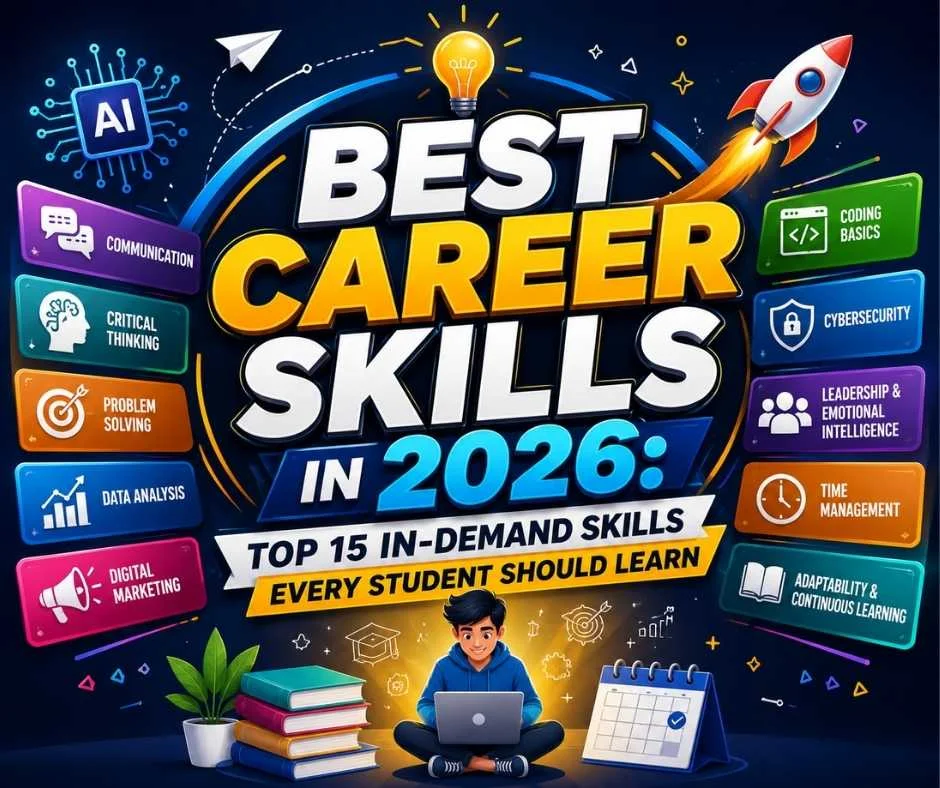
The Best Career Skills for Students in 2026 include communication, digital literacy, AI awareness, critical thinking, problem-solving, time management, teamwork, adaptability, creativity, leadership, emotional intelligence, financial literacy, networking, research, data literacy, coding, writing, and continuous learning.
Students should remember that skills become more valuable when they are applied. Reading about communication is useful, but practicing presentations is better. Learning about coding is helpful, but building a project provides practical experience. Understanding marketing is valuable, but creating a real campaign can provide deeper learning.
The Best Career Skills for Students in 2026 can help students become more confident, adaptable, and prepared for different professional opportunities.
Start with a few skills, practice them consistently, learn from mistakes, and gradually expand your abilities. With patience and continuous effort, students can build a strong foundation for their future careers.
Frequently Asked Questions
1. What are the Best Career Skills for Students in 2026?
The Best Career Skills for Students in 2026 include communication, digital literacy, AI awareness, critical thinking, problem-solving, teamwork, adaptability, creativity, leadership, time management, financial literacy, research, and technical skills.
2. Why are career skills important for students?
Career skills help students apply their academic knowledge in practical situations. They can also support communication, collaboration, problem-solving, and professional development.
3. Should students learn AI skills?
Yes. Basic AI awareness can help students understand modern technologies, use AI tools responsibly, verify information, and explore new learning and career opportunities.
4. How can students improve their career skills?
Students can improve through projects, internships, online courses, competitions, volunteering, presentations, teamwork, networking, and regular practice.
5. Are soft skills still important in 2026?
Yes. Communication, teamwork, adaptability, leadership, creativity, and emotional intelligence remain useful alongside technical abilities.
6. When should students start developing career skills?
Students can start at any stage. Beginning early gives them more time to explore interests, practice abilities, build projects, and learn from experience.
7. How can students show their skills to employers?
Students can demonstrate their abilities through résumés, portfolios, projects, internships, certifications, presentations, competitions, and relevant work samples.
8. Which technical skills should students learn?
The right technical skills depend on career goals. Students may explore coding, data analysis, digital marketing, design software, AI tools, cybersecurity basics, or other technologies relevant to their chosen field.
9. Can career skills help students become entrepreneurs?
Yes. Communication, financial literacy, marketing, leadership, problem-solving, creativity, adaptability, and digital skills can support students interested in entrepreneurship.
10. What is the most important thing about career preparation?
Consistency is important. Students should focus on learning useful skills, applying them through practical activities, accepting feedback, and continuously improving.
Conclusion
The professional world of 2026 offers students many opportunities, but preparation requires more than academic qualifications. Students can strengthen their future prospects by developing practical abilities alongside their education.
The Best Career Skills for Students in 2026 provide a useful foundation for personal growth, higher education, internships, employment, entrepreneurship, and lifelong learning. By starting early and practicing consistently, students can gradually develop the confidence and abilities needed to navigate an evolving career landscape.